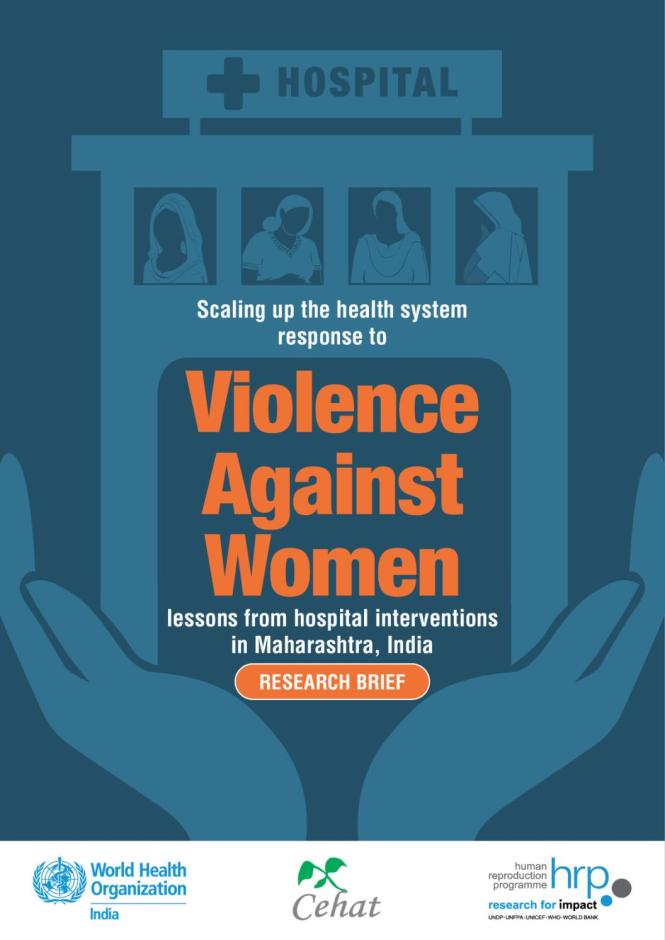
Scaling Up the Health System Response to Violence against Women: Lessons from Hospital Interventions in Maharashtra, India
September 27, 2021

Scaling Up the Health System Response to Violence against Women: Lessons from Hospital Interventions in Maharashtra, India

Violence against women (VAW) is a major public health concern, a manifestation of gender inequality and a human rights violation. Intimate partner violence1 is the most common form of violence experienced by women. Violence has significant and long-lasting impacts on women’s physical health, including sexual, reproductive and mental health. Women who have experienced violence are more likely to seek health care than non-abused women . Health-care providers (HCPs) are well-placed to identify women who have experienced violence and to provide appropriate clinical care and referrals.
Violence against women (VAW) is a major public health concern, a manifestation of gender inequality and a human rights violation. Intimate partner violence1 is the most common form of violence experienced by women. Violence has significant and long-lasting impacts on women’s physical health, including sexual, reproductive and mental health. Women who have experienced violence are more likely to seek health care than non-abused women. Health-care providers (HCPs) are well-placed to identify women who have experienced violence and to provide appropriate clinical care and referrals.
Organizations:

WHO India Center for Health and Enquiry into Allied Themes (CEHAT) UNDP-UNFPA-UNICEF-WHO-World Bank Special Programme Research, Development and Research Training in Human Reproduction (HRP)

Share article: