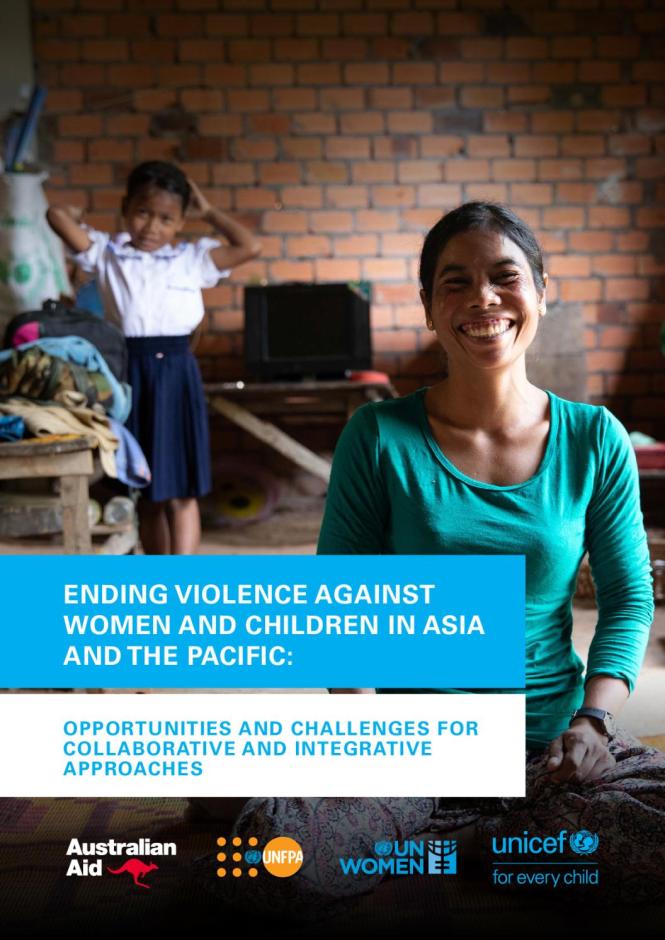
Ending Violence against Women and Children in East Asia and Pacific
August 6, 2021

Ending Violence against Women and Children in Asia and Pacific: Opportunities and Challenges for Collaborative and Integrative Approaches

Violence against women and children are linked. These harms share risk factors, including a lack of responsive institutions and weak legal actions against violence. These forms of violence are also both fueled by the harmful social norms that condone violent discipline, promote toxic masculinity, prioritize family reputation and blame victims – all of which perpetuate gender inequality. Intimate partner violence (IPV) and VAC often co-occur within spaces and relationships of trust, such as in the home or in schools. Evidence indicates that children in households affected by IPV are more likely than other children to experience violent discipline by both male and female caregivers. Further, witnessing IPV may have long-term health and social consequences similar to the impact of direct abuse.
Violence against women and children are linked. These harms share risk factors, including a lack of responsive institutions and weak legal actions against violence. These forms of violence are also both fueled by the harmful social norms that condone violent discipline, promote toxic masculinity, prioritize family reputation and blame victims – all of which perpetuate gender inequality. Intimate partner violence (IPV) and VAC often co-occur within spaces and relationships of trust, such as in the home or in schools. Evidence indicates that children in households affected by IPV are more likely than other children to experience violent discipline by both male and female caregivers. Further, witnessing IPV may have long-term health and social consequences similar to the impact of direct abuse.
Organizations:

United Nations Children’s Fund (UNICEF) United Nations Population Fund (UNFPA) UN Women (United Nations Entity for Gender Equality and the Empowerment of Women)

Share article: